
Some Alarming Developments in Photojournalism
Photojournalists' pay and protections have steadily been eroded, even when legacy news outlets have demanded more from them
Dear Reader,
Over the roughly six years I’ve worked as a photojournalist in East and Southern Africa, covering various beats for international publications, I’ve witnessed the changes rippling through the media industry firsthand — even without being formally employed as a staff photographer in a newsroom. And they are palpable.
Legacy media such as The New York Times and The Wall Street Journal have been quick to adopt front-facing reels and video clips. The stilted way these strategies are adopted makes it clear that these publications are acting out of a fear of irrelevance in the face of the mind-numbingly effective algorithm, not because these features contribute to deeper or more nuanced reporting.
I’m not the only contributor resentful of being forced to take shitty B-roll for these outlets: we aren’t paid more to do so, and it ultimately detracts from the quality of the still images that should be at the heart of each commission. That’s because with each new feature, we’re scrambling to do more without additional resources beyond what we pull from ourselves.
I’m not prescriptively against change. But there should be deeper discussions about what B-roll or reporter-focused videos are bringing to the table. I recently met with a photo editor at The New York Times, who took a chance on me back in 2022. We chatted about the different formats they are experimenting with, as well as the many changes happening behind the scenes at the science desk and its columns. “We’ve been through this so many times,” he tells me. “Every so often, there’s something we have to care a lot about, like Facebook Live, and then it passes.”
All of this pales in comparison to the ongoing debacle over The Wall Street Journal’s new photo contractor agreement. It’s important to note that the Journal has no staff photographers, relying entirely on freelance contributors around the world and image syndication through wire agencies like Agence France-Presse and Getty.
In late 2025, all Journal contributors were sent a new standard contractor agreement that we were required to sign to accept new assignments. Two changes set off alarm bells: the change in authorship terms for images created on assignment — no more joint authorship — and the Journal’s ability to sublicense images without restrictions, including to companies developing artificial intelligence technologies. (Note: At The Xylom, I retain the rights to any photos I take; Alex notifies me whenever other news outlets or entities pick up my photos, and we don’t sublicense any images to any AI companies.)
Four regular Wall Street Journal contributors created an anonymous group called Your Visual Colleagues to beseech the Journal to reconsider the changes to their contract: not only the sub-market editorial day-rate, but more critically, how it would force contributors to relinquish ownership of work made on assignment to Dow Jones, the News Corp-owned company that publishes The Journal.
More than 650 photographers who have worked with the Journal have signed on, including me. This level of cohesion is unprecedented: it’s hard to get that many photographers to agree on anything. Daniella Zalcman, one of the co-founders of Women Photograph, who has worked in photojournalism for two decades, says she has never seen photographers so unified or angry.
It was a choiceless yet sad option. The Journal’s Nairobi-based bureau chief, Mike Phillips, and world photo editor, Angela Owens, are two of my favorite people to work with. Mike is a close friend and excellent reporting partner; Angela has always had my back and stands out for her kindness in an industry marred by intrinsic power imbalances, which the vast majority of editors take full advantage of.
Last year, before the new contract, I was on assignment for them for roughly 15 days, from the Democratic Republic of Congo and Rwanda to Uganda. The stories I’ve worked on with The Journal gave me access and resources that would otherwise have been difficult to come by, and resulted in memories that will stick with me — and some very gratifying spreads.
But it would be self-defeating to contribute to a trajectory that would ultimately take away what my colleagues and I have to offer: ground reporting that makes a story visually rich, contextual, and empathetic. Particularly at a time when truth is under incessant questioning, indirectly releasing ownership of images we make — sometimes at the cost of blood, sweat, or parasitic infections — to what journalist Gil Duran describes as “the Nerd Reich” is a line in the sand we have collectively decided not to cross.
No one pays for independent contributors’ health insurance, retirement, gear, or security, or ensures our mental well-being in conflict or conflict-adjacent zones. In an industry that offers zero stability or support, signing that contract would be akin to self-sabotage.
Warmly,
KC Cheng
Editor-at-Large
🍄 ICYMI: Ukrainian Mycologists Are Not Giving Up
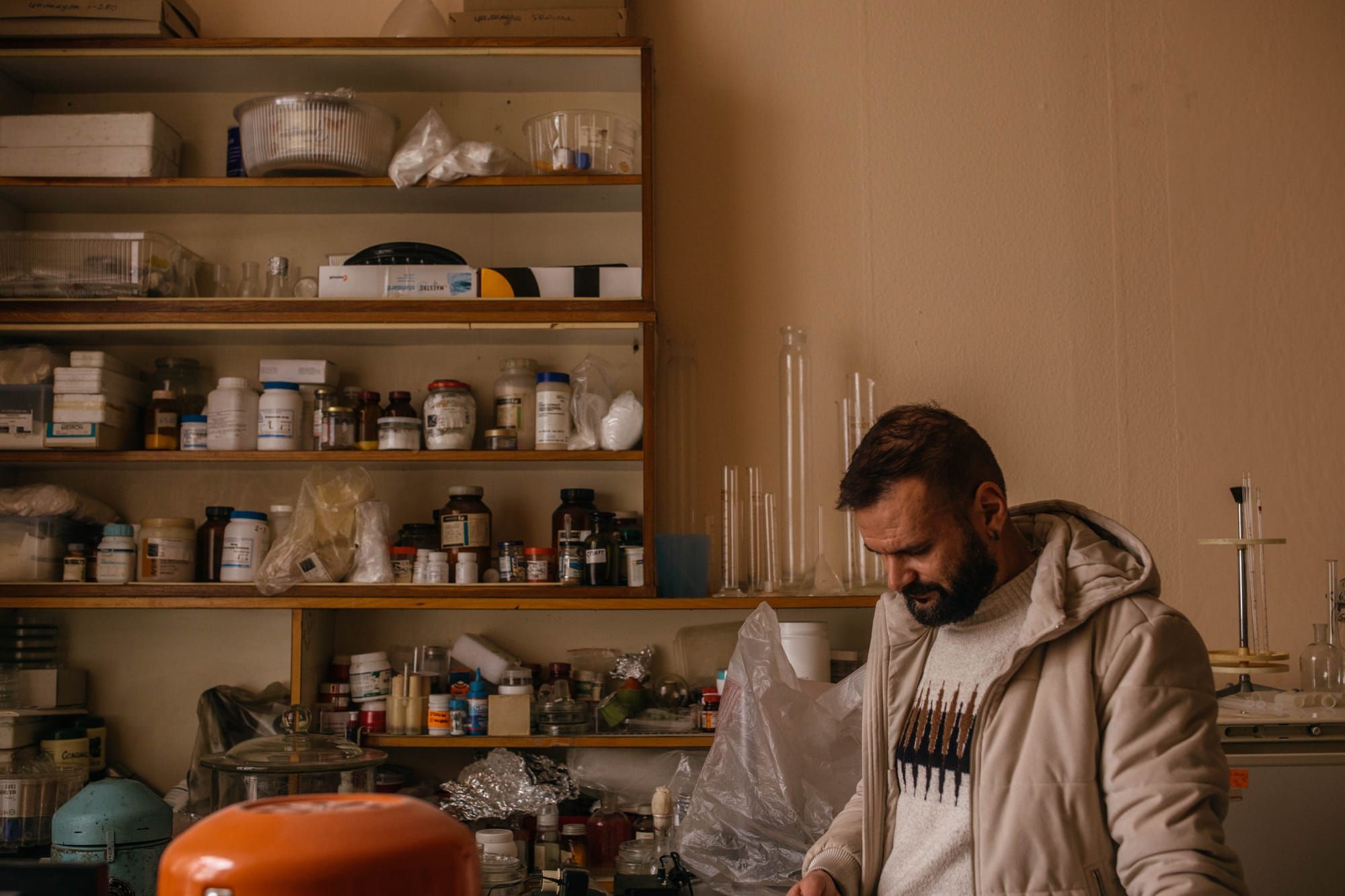
More than four years after Russia’s full-scale invasion, fungi scientists at the M.G. Kholodny Institute of Botany have been forced to adapt to increasingly difficult working conditions.
“Expensive reagents [which need to be kept at -20ºC] are spoiling in refrigerators,” wrote researcher Galeb Al-Maali. “We have a large collection of fungi — which are also stored at low temperatures — that are currently under threat of extinction.”
Read a dispatch by our Editor-at-Large Kang-Chun Cheng from Kyiv, Ukraine here.
🌞 NEWS BEHIND THE NEWS
🏔️ Our contributor Saugat Bolakhe, who was born and raised in Nepal, shares a heartbreaking perspective on the bad news that keeps coming out of the country.
🎓 Congrats to our contributor Samuel Ajala, who has recently started his Ph.D. in Environmental Dynamics at the University of Arkansas!
LOVE this newsletter? The best way you can support our independent reporting is to share it with a friend. Join our community now:


Add a comment: