
The Xylom Nabs First Online Journalism Awards Finalist Nod
Dear Reader,
Happy weekend! Before we move on to our news digest, I’ve got some good news to share:
Yesterday, The Xylom was named a 2026 Online Journalism Awards Excellence in Science Reporting (Small/ Medium Newsroom) finalist for my series ‘All Hell Breaks Loose’: How Big Oil Ruined a Small Texas Town!
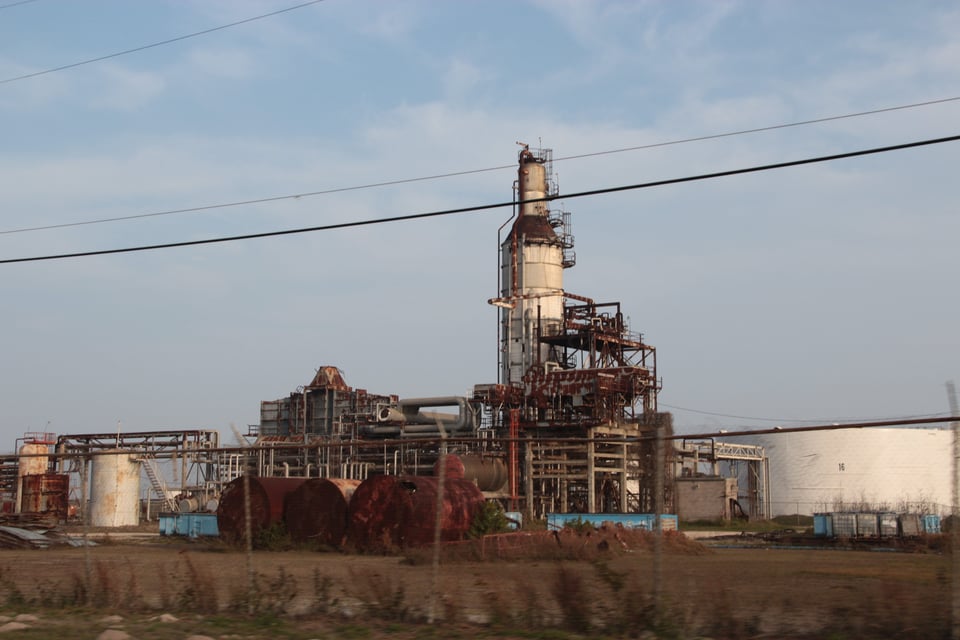
Unlike most categories that were divided into large, medium, small, and micro divisions, we competed alongside news outlets with up to 250 employees. The Xylom, with only two full-time staff and a $165,450 budget, punched above its weight; other finalists in our category include ProPublica and Scientific American. The winners will be announced next week in a virtual ceremony.
Again, this work is impossible without your support. The Xylom is a worker-led, reader-funded news outlet. Please consider making a tax-deductible donation today to support more award-winning in-depth reporting on the world’s most pressing health and environmental disparities.
Yes! I support The Xylom!Best regards,
Alex Ip
Publisher and Editor
🍑 A SOUTHERN FLAIR
LEON COUNTY, Fla. — Grand jury finds DeSantis administration "misappropriated" $10 million in taxpayer money to Hope Florida (Jim DeFede, CBS News)
The grand jury report said the money, which was supposed to be used to provide health insurance for poor children, was instead hastily passed through multiple organizations before eventually landing in the bank accounts of two political action committees and the Republican Party of Florida. Those funds were then used in 2024 to defeat Amendment 3, the citizen initiative to legalize marijuana in Florida.
BRUNSWICK, Ga. — Potent, mislabeled and easy to buy: Inside Georgia’s kratom market (Justin Taylor, The Current)
Despite documenting misleading labeling as far back as 2018, Georgia has not created a regulatory body or funding mechanism for law enforcement agencies to test whether kratom products violate the law — a situation that public health officials and some industry supporters say endangers hundreds of consumers.
NASHVILLE, Tenn. — Dolly Parton dies aged 80 — researchers celebrate her contributions to science (Elizabeth Gibney & Dhruv Shenai, Nature)
“Dolly Parton chose not to be a billionaire,” wrote Carlie Trott, a social psychologist at the University of Cincinnati, Ohio, on Bluesky. “She never forgot what it means to be in need.”
Like what you read so far? Subscribe and share it with a friend:
🟠 TRACKING TRUMP
RFK Jr lied in Senate confirmation hearings, newly revealed documents indicate (Michelle R Smith, The Guardian)
In one he wrote to the Samoan prime minister before the trip, Kennedy explicitly said he wanted to study the measles, mumps and rubella (MMR) vaccine in the Pacific island nation. In it, he used the words “vaccine” or “vaccination” eight times.
WEST POINT, N.Y — West Point professor fired after pushing back on limitations to teaching climate change, lawsuit says (Rose L. Thayer, Stars and Stripes)
Adam Kalkstein, a climate scientist who spent 17 years teaching future Army officers, said he consistently received “outstanding” appraisals of his work. When leadership last year imposed a ban on teaching that humans contribute to climate change, he tried to comply but ultimately pushed back, saying that it was a disservice to the cadets’ education.
Clean Air Policies Help Kids Breathe and Think Better (Keerti Gopal, Inside Climate News)
“We’ve seen the damage that air pollution can do, but we’ve shown that it’s not permanent,” said [Helen Wood, a research fellow at Queen Mary University of London]. “Look what we can do if we make the air cleaner.”
TORONTO — Canada Hires 48 Scholars Away From Top U.S. Universities (Vjosa Isai, The New York Times)
“I used to live in the country that I thought was the most enthusiastic about the prospects for science improving the human condition, of any country in the world,” said Phillip Zamore, the chair of RNA Therapeutics Institute at the University of Massachusetts. “And I woke up one day and that wasn’t true anymore.”
He has been recruited to McGill University in Montreal, which has also hired five other researchers, and will join the medical faculty.
“If scientists don’t stand up for truth, no one will,” Dr. Zamore said.
🗺️ WHAT ELSE WE'RE READING
NEPAL-CHINESE BORDER — How a glacier collapse triggered a deadly landslide and flooding along the Nepal-China border (Reuters Graphics staff)
“It was a huge gush of mud coming straight towards us,” said Keshav Prasad Baral, a 68-year-old survivor being treated in a Nepali hospital.
“As it got closer, it kept rising higher and higher. When I saw it enter our home, I tried to grab my wife’s hand and take her to the terrace. But she was swept away by the mud.”
Read more: Floods wipe out local governments’ ability to lead rescue, relief (Ganga BC, The Kathmandu Post)
ZAMBEZIA PROVINCE, Mozambique — A ‘leading’ Chinese miner of Mozambique’s heavy sands linked to environmental destruction (Malavika Vyawahare, Mongabay)
“What concerns me the most is the fact that some of these projects are implemented without having any environmental impact assessment,” said [Fatima Mimbire, an advocate for transparency in Mozambique’s mining sector] who is also a member of the steering committee for the Extractive Industries Transparency Initiative, a Norway-based group that works on improved natural resource governance. Mozambique became a member of EITI in 2009.
OHIO — As Ohio grapples with fake comments on clean energy, some want crackdown (Kathiann M. Kowalski, Canary Media)
“It skewers the whole process, and you don’t know who to trust,” said Beth Nagusky, an adjunct law professor who has taught at Case Western Reserve University and Cleveland State University and who was previously a utility regulator in Maine.
Police Are Spending Opioid Settlement Funds on Flock Cameras (Schuyler Mitchell, Mother Jones)
“It’s just really not the way to make the most impact in addressing addiction,” said [Robyn Oster, director of policy at the nonprofit Partnership to End Addiction]. “While $50 billion may seem like a lot of funds, once it’s divided up over 18 years and thousands of localities, a lot of places really aren’t getting that much, particularly given the scope of the crisis…Whatever funds you’re spending on a camera, you’re not spending on getting someone into treatment.”
How much of a problem is AI’s water use? (Katarina Zimmer, Knowable Magazine)
ALWAR, India — India is turning to ancient water systems as modern ones run dry (paywalled) (Ankit Mishra, BBC)


Add a comment: