
Unpacking The Nepal-Tibet Floods
Dear Reader,
It’s been a hectic week of wrapping up pending work, packing bags, spending extra time with my toddler before I’m away from him for a week, and squeezing in gym sessions.
And now, I’m off to Sri Lanka for my first-ever international reporting trip. I’ll share more about it soon. Wish me luck!
And don’t forget to catch up on the top stories on the world’s most pressing health and environmental disparities below.
Best regards,
Laasya Shekhar
Managing Editor
🏔️ HOT OFF THE PRESSES: How Did The Nepal-Tibet Floods Become This Deadly?
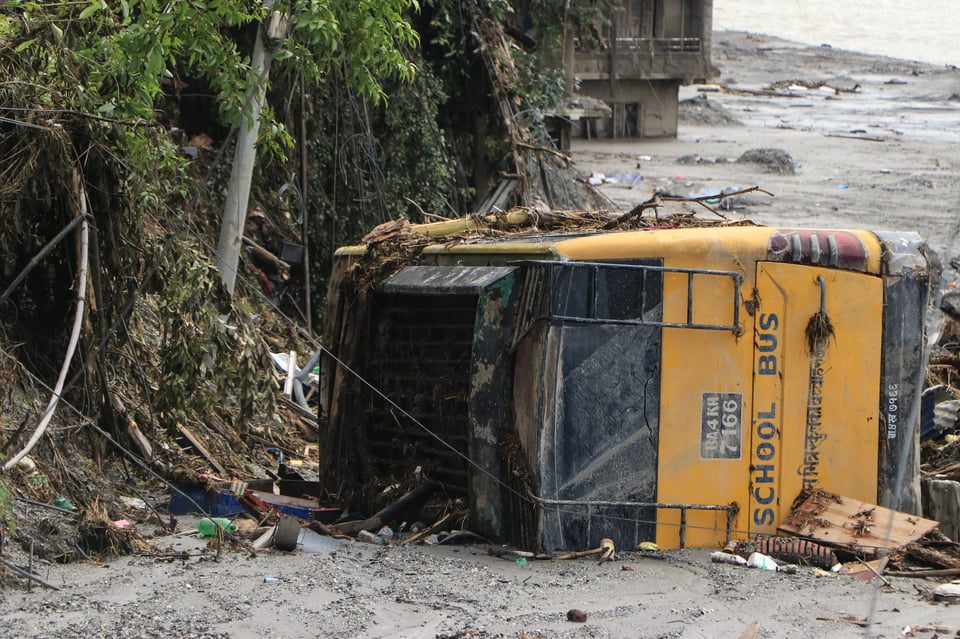
NEW: Scientists are piecing together the factors that led to the disastrous Nepal-Tibet floods, which have also exposed gaps in cross-border information sharing on hazards in the rapidly changing Himalayas. Read a dispatch by tanka dhakal and Manish Aryal from Rasuwa District, Nepal here.
Read more Nepal-Tibet flooding coverage from our colleagues:
KATHMANDU, Nepal — Nepal puts climate justice at centre of global pitch for flood aid (Saurabh Sharma, Sarita Chaganti Singh and Gopal Sharma, Reuters)
As Nepal identifies those killed in the floods, questions grow over China's reporting (Jennifer Pak, NPR)
🍑 A SOUTHERN FLAIR
RIO GRANDE — When is a river no longer a river? (Jack Herrera, Texas Monthly)
On a map the Rio Grande appears as a blue line that travels from Colorado all the way to the Gulf of Mexico. That line is a lie. By the time the river makes it past El Paso, it has fed so many fields of potatoes, cotton, and pecans that no water remains. For most of the year, the Rio Grande runs dry for the next two hundred miles through what some call the Forgotten Reach.
This is perhaps the most important fact to understand about the Rio Grande: Human activity has turned it into two rivers. The upper Rio Grande flows from the headwaters. The lower Rio Grande comes from somewhere else.
PENSACOLA, Fla. — Vouchers Promise Students With Disabilities a Path to Private School. Parents Say That’s Not the Reality. (Jennifer Berry Hawes & Jennifer Smith Richards, ProPublica)
“Our kids can’t go to a private school,” said Christy Black, an advocate for Disability Rights of West Virginia who has a daughter with Down syndrome. “I called every private school from Huntington to Charleston because that’s as far as we could drive her and work. But no one would accept her because she has a cognitive disability.”
BELHAVEN, N.C. — In North Carolina, a race is on to restore critical peatland before it dries up or is destroyed (Tammy Webber & Joshua A. Bickel, The Associated Press)
“We’ll lose 5, 6 feet of peat in a matter of weeks, which equates to millions of tons of carbon loss — ancient carbon loss that we simply can’t ever get back in human lifetimes,” says Duke University ecologist Curtis Richardson.
FLORIDA — As Extreme Weather Worsens, Black and Hispanic Homeowners Are Paying More for Insurance (Amy Green, Inside Climate News)
The inequities add up to at least $28,500 in additional insurance costs over the span of a 30-year mortgage for homeowners in Hispanic communities and $15,000 for homeowners in Black communities, according to the report.
COLLEGE STATION, Texas — From Polka Music to Scientific Breakthrough: An Accordion’s Unlikely Assist in Heart Research (Sarah Amandolare, MedScape)
🟠 TRACKING TRUMP
WASHINGTON — Trump’s Beef Import Plan Could Bring Down Prices — and Drive Up Emissions (Jessica Scott-Reid, Sentient)
“Farmers and ranchers are extremely disappointed to learn that President Trump plans to flood the American market with hundreds of millions of pounds of foreign-raised beef. The U.S. is already importing beef at record levels,” said American Farm Bureau Federation President Zippy Duvall in an August 21 statement.
Ectopic Pregnancy Deaths Have Nearly Doubled. It’s Worse in States With Abortion Bans. (Andrea Suozzo and Agnel Philip, ProPublica)
“Reproductive health is unusual across medicine when we consider how swiftly policy changes affect the care patients can receive,” said Dr. Courtney Schreiber, a professor of obstetrics and gynecology.
US states sue Trump administration for weakening endangered species protections (Jonathan Stempel, Reuters)
"The Trump administration is trying to undermine the law, the will of Congress and the will of the people who overwhelmingly support protections for endangered species," Washington Attorney General Nick Brown said at a press conference. "Instead of stewardship, this administration's approach to our land, to our water is one of exploitation."
Like what you read so far? Subscribe and share it with a friend:
🗺️ WHAT ELSE WE'RE READING
PHOENIX — Arizona accuses L'Oreal of concealing cancer risks linked to hair relaxers (Diana Novak Jones, Reuters)
“The lawsuit accuses L'Oreal of violating state consumer protection laws by marketing the products, which are used predominantly by African American women, without warning consumers about the alleged risks of ovarian and uterine cancers,” writes Jones.
BOSTON — Massachusetts hits data centers with new clean power rules (Tim De Chant, TechCrunch)
“Under Gov. Maura Healey’s order, data centers larger than 25 megawatts of peak demand will have to bring their own power and guarantee that it adheres to the state’s clean energy requirements,” writes Tim De Chant.
CAIRO — What A Bunch Of Grapes Carries: The Water And Women Behind Egypt’s Agriculture Export (Yasmine Hussein & Roger Anis, The Contrapuntal)
When asked about her dream, a farm worker replied, “I would organize the work and abide by the law. I would provide safe transportation and meet the workers’ needs. I would pay them EGP 250 a day instead of 130, because I would count their workday as starting from three in the morning.”
NEW YORK — After 9/11, Documents Suggest, New Yorkers Were Misled About Air Quality (Sally Goldenberg and Nina Agrawal, The New York Times)
“On Friday, we will mark 25 years since the worst tragedy ever to befall our city, the darkest day New York City has ever known,” Mayor Zohran Mamdani said on Tuesday at a news conference to introduce the records.
“And yet the devastating truth is that the suffering did not end once the smoke cleared and the dust settled.”
“People got sick because the leaders they trusted lied and told them they were safe to breathe in toxic air,” Mr. Mamdani added.
Madison, Wisc. — UW-Madison students, records detail investigation of professor (Ella Hanley and Danielle DuClos, The Capt Times)
Researcher, heal thyself: meet the scientists studying their own diseases (Josie Glausiusz, Nature)
TEMPE, Ariz. — ASU heat policies raise questions about life-threatening workout (paywalled) (Robert Anglen, The Arizona Republic)
Read more: The world is adapting to extreme heat — but not nearly fast enough (Kate Yoder, Grist)


Add a comment: