
Tough Times for International Journalists
Dear Reader,
Happy weekend.
When our Editor-at-Large Kang-Chun Cheng embarks on a reporting trip, she pitches and receives assignments from numerous news outlets on various topics to make ends meet. Such is the reality of doing international journalism in Trump 2.0 (see Friend of The Xylom Nithin Coca’s excellent dispatch below).
Through this process, KC offers us valuable takeaways on potential newsroom partners and journalism funding models; it helps us pool funds to get her to a living wage.
Next week, you will read on KC’s feature for us on Ukraine’s fungal ecosystems. But before that, here is another story by KC, Ukraine’s Pièces de Résistance, published by our friends at Hidden Compass:
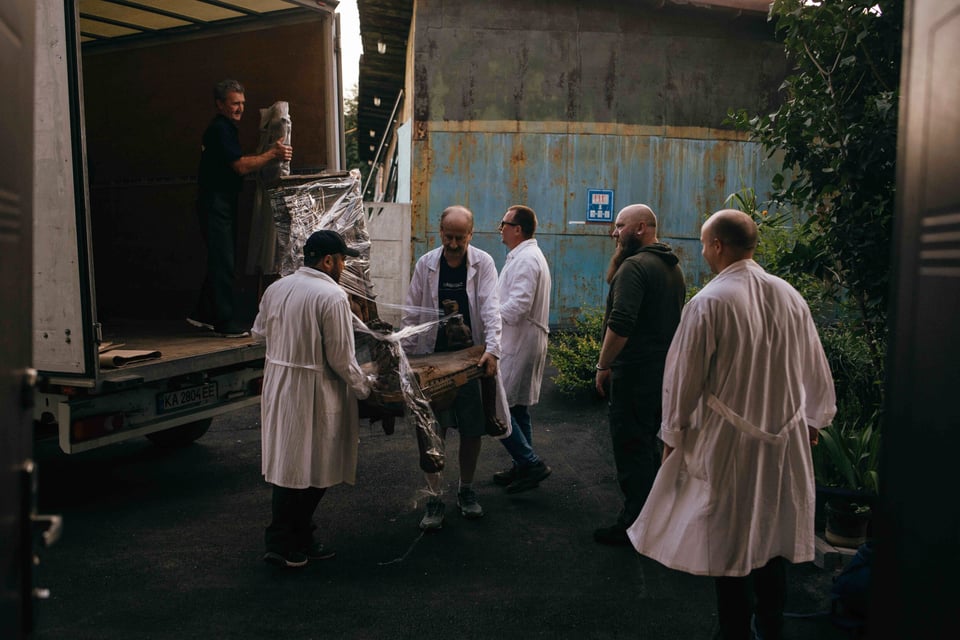
In the bloodbaths across eastern Ukraine, sacrifices happen every hour as Ukraine’s soldiers struggle to keep the soldiers and mercenaries of the world’s biggest country at bay amid the deadliest war in Europe since World War II. But away from the front lines, art restorers and museum curators confront more existential questions.
How much does art matter when lives are at stake?
Please consider using the tip jar on the story page to directly support KC and our counterparts at Hidden Compass.
And now, here’s a news digest on the world’s most pressing health and environmental disparities:
Warmly,
Laasya Shekhar
Managing Editor
🍑 A SOUTHERN FLAIR
NORTH CAROLINA — North Carolina poultry industry grows as manure oversight lags, report finds (Brian Bienkowski, The New Lede)
“The biggest issue is that [dry litter poultry farming] has nearly no regulatory oversight,” said Al Rabine, a senior geospatial analyst at Environmental Working Group. “Farmers put massive amounts on the fields … and, when they store it, they can keep it in uncovered piles for 15 days,”
FLORIDA — How Florida quietly removed climate change content from textbooks (Jessica Meszaros and Katie Worth, The Hechinger Report)
“These are not changes that were required to bring the textbooks in line with the state science standards,” said Glenn Branch, deputy director of the National Center for Science Education, a nonprofit that tracks how climate is taught in classrooms across the country. “Demanding that the treatment of climate change be weakened in these textbooks is very unusual.”
WESTOVER, Ala.— Proposed Data Centers Could Use More Electricity Than All Alabama Homes Combined, Analysis Shows. Who Will Pay? (Lee Hedgepeth, Inside Climate News)
“How much SB 270 actually ends up protecting customers is fully dependent on how the PSC enforces the law,” said Daniel Tait, executive director of Energy Alabama, a nonprofit that advocates for clean energy in the state.
“I don’t think the public has a reason to trust Alabama Power when it comes to protecting them from costs, but they should look to the Public Service Commission to step in and hold the power company to its word.”
COVINGTON, Ga. — Regulators to decide if Georgia law allows data center’s pop-up gas power plant (Drew Kann, The Atlanta Journal-Constitution)
“Ultimately, we need a public decision about whether VoltaGrid’s proposal is violating state energy laws so that all energy providers in Georgia are playing by the same rules,” said Morris Carter, president and co-founder of Sustainable Newton, a local nonprofit. “This is an important step closer to that goal.”
MEMPHIS, Tenn. — The Weight of Air (Kevin Wurm, MLK50: Justice Through Journalism)
“I feel like I deserve to breathe clean air,” said Boxtown resident Sarah Gladney. “We the people deserve to breathe clean air; that’s why I fight.”
DALLAS — Baby with heart defect at center of US surrogacy dispute handed to parents (Edward Helmore, The Guardian)
I felt very trapped due to this contract. I felt like I had no voice,” said surrogate mother McKenna West, referring to a surrogacy agreement. “But I knew in my soul, in my heart that I wanted to protect this little boy.”
CHARLOTTE, N.C. — Ticks that cause Lyme and other diseases have migrated south. Are doctors ready? (Erika Edwards, NBC News)
CORPUS CHRISTI, TEXAS — How Corpus Christi’s water emergency exposed flaws in Texas’ water planning (Alejandra Martinez, The Texas Tribune)
Like what you read so far? Subscribe and share it with a friend:
🟠 TRACKING TRUMP
Walking Targets (Uyiosa Elegon, Columbia Journalism Review)
“As nonprofit newsrooms, we’re struggling with both the attacks on journalism and the attacks on philanthropy,” Lara Witt, Prism’s editor in chief, said.
“We did deal with the COVID years where philanthropy retracted a little bit, but this is different because it’s legal, it’s structural, it’s fascism.”
BANGKOK — U.S. investment in international reporting is shrinking, taking international journalists’ opportunities with it (Nithin Coca, The Objective)
Trump was arguably re-elected in part because most Americans have a limited understanding of our place in the world, and U.S. news has played a crucial role in spreading negative stereotypes about immigrants, Muslims, and other groups. And, in the frenzy to cover Trump, newsrooms are covering the world even less and neglecting an opportunity to amend past harmful coverage — leaving American readers more ignorant and less informed of our place in an increasingly complex, interconnected world.
WASHINGTON — “Sabotage”: Experts, lawmakers blast RFK Jr. for destroying healthcare research (Beth Mole, Ars Technica)
During Trump’s second term, DOGE cuts led to the firing or retirement of an estimated 75 percent of the AHRQ staff. In July, AHRQ abruptly sent grant cancellation letters to around 150 researchers. More than 100 research grants collectively worth over $250 million have been canceled.
🗺️ WHAT ELSE WE'RE READING
ZAMBOYE, Central African Republic — CAR: Scores killed in landslide at illegal gold mine (John Shelton, DW News)
Video uploaded to social media platforms showed bodies churning in earth as the landslide lunges into the open-pit site beneath, burying everything in its path.
Roundtable: Unpacking China’s five-year plan for coal (Lin Zi, Dialogue Earth)
“The big picture on coal is that China’s planners are aiming to stabilise consumption by 2030, allowing for an increase in the early years of the plan period, instead of the earlier commitment to gradually reduce coal consumption during the 2026-30 period,” says Lauri Myllyvirta, co-founder, Centre for Research on Energy and Clean Air.
In a drier world, some infectious diseases are unexpectedly thriving (Sachi Kitajima Mulkey, Grist)
Tracking disease is fundamentally about the movement of animals that carry it, said Georgia Titcomb, a wildlife disease ecologist and assistant professor at Colorado State University.
“Throughout history, living things have been moving to get water, and so when there are massive changes to the way water is distributed on the landscape, we’re going to also expect big changes in the ways animals move to access that water,” she said. “That’s going to remove some opportunities for transmission, and introduce new ones too.”
Bidenomics Was More Successful Than People Think (Leah Stokes, The Atlantic)
… we identified 234 House districts that saw a total of 523 clean-energy factories announced during the Biden years and compared them with demographically similar districts that weren’t slated for factories.
Over the four presidential elections preceding 2024, voting patterns in these two sets of districts moved in lockstep, rising and falling together with the national tides. Then, they split. In 2024, we found that clean-energy manufacturing lifted Harris’s vote share by roughly 1.5 percentage points—a swing of 2.5 million votes across the 234 districts. For context, Trump won the national popular vote by just 2.3 million.


Add a comment: